The financial system of record for insurance billing
tigerbilling owns the money side of insurance — invoicing, installments, collections, reconciliation, disbursements, and the close — on a single double-entry ledger where every amount traces back to its postings.
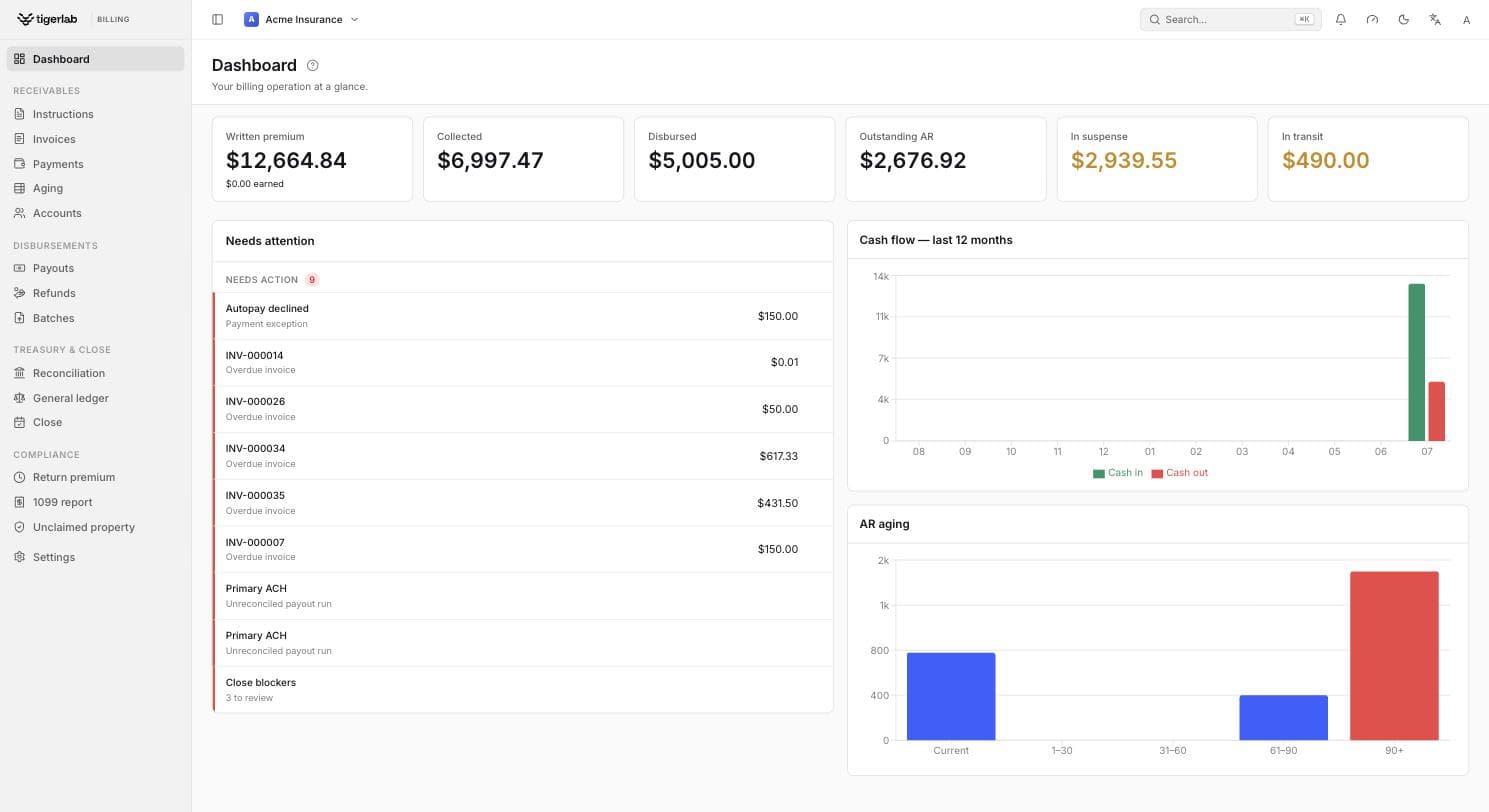
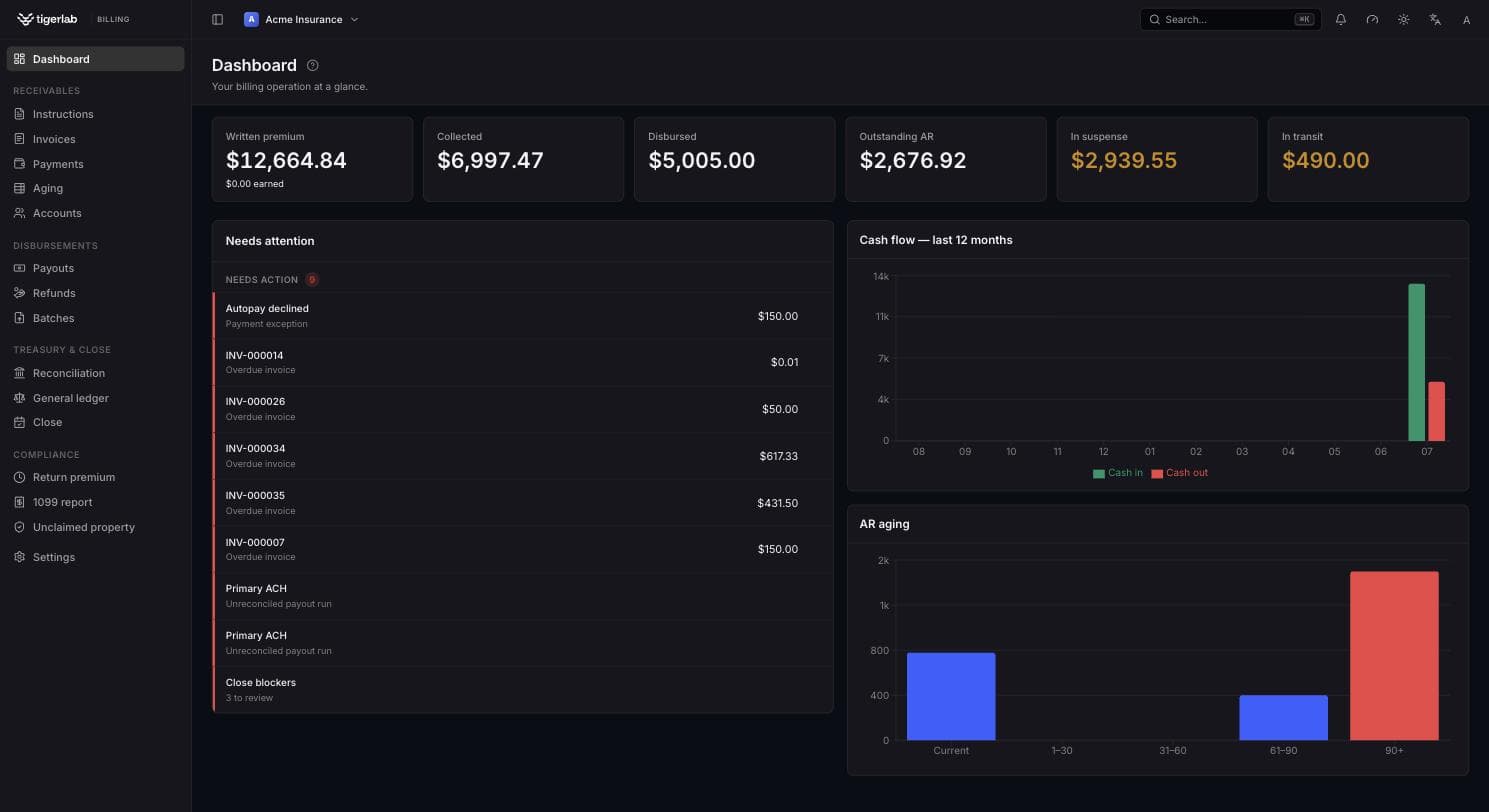
Every number, provable. One append-only ledger underpins every screen, so at the close the books tie out — or they don’t.
It takes rated charges from policy administration and turns them into receivables, cash, statements, and ledger truth. It never rates policies and never processes payments itself, so the boundary stays clean and every figure stays auditable.
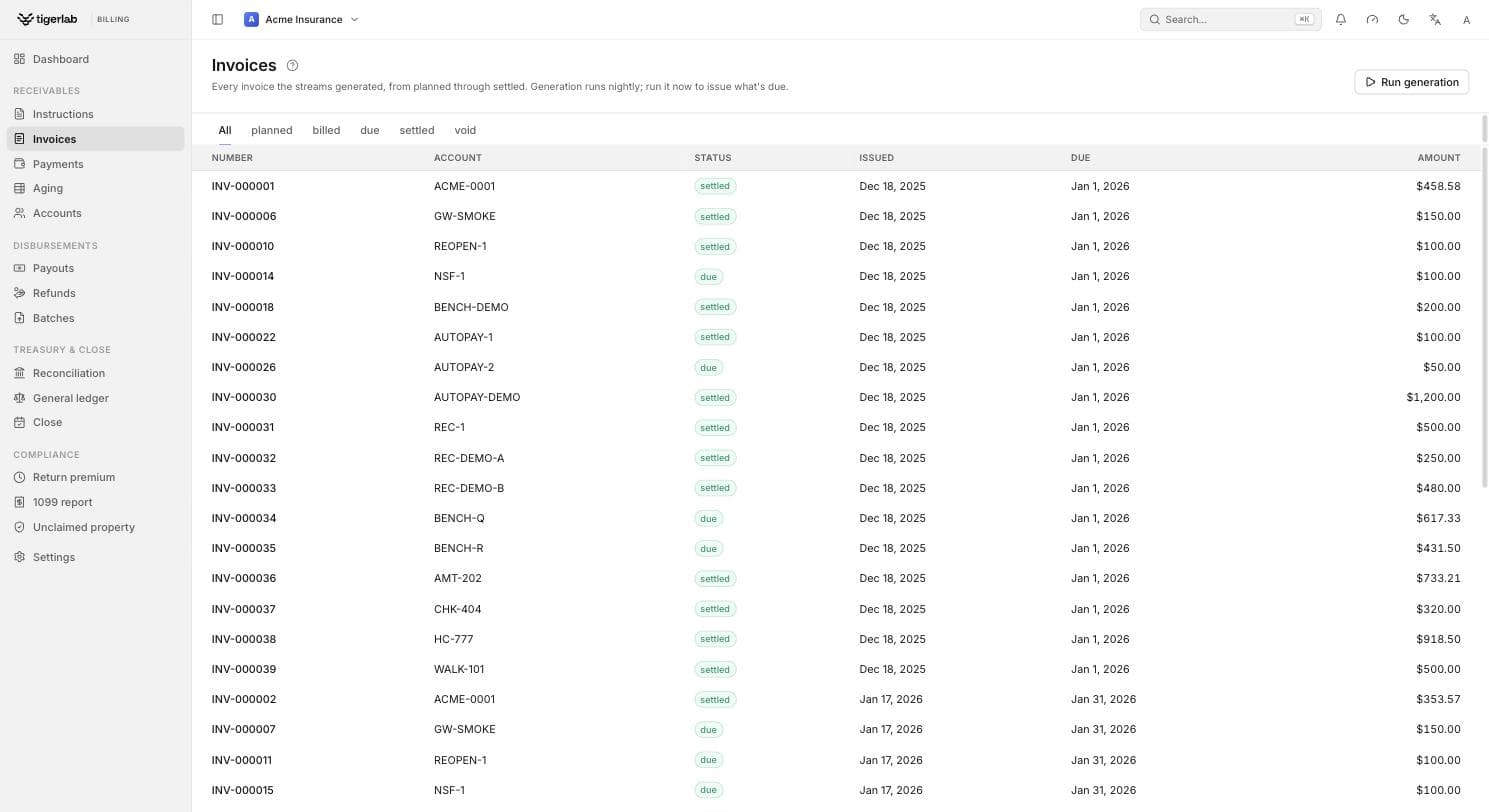
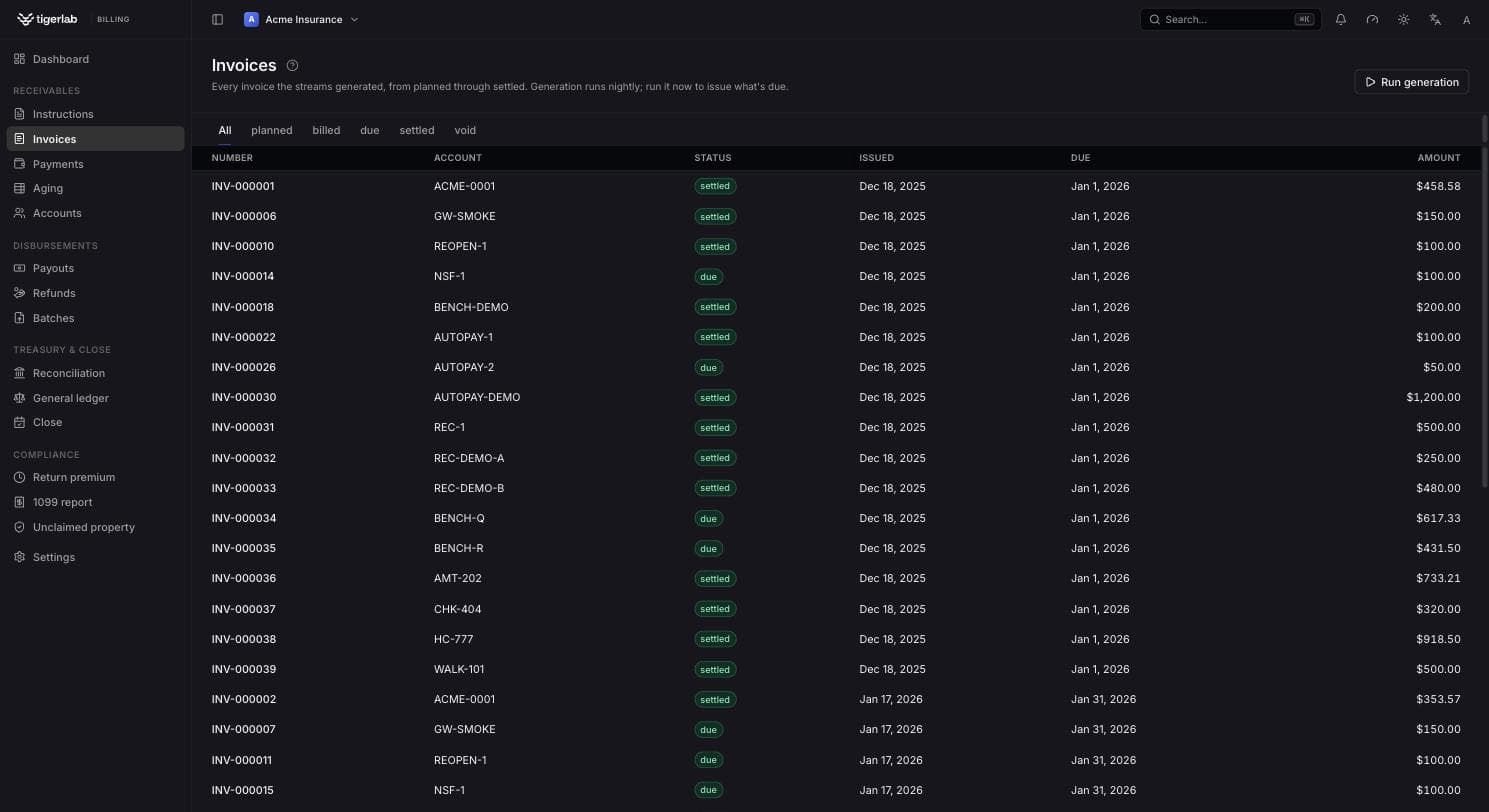
Invoicing from planned to settled
Account-centric invoice streams move through planned, billed, due, and settled — with aging and PDF invoices emailed to payers.
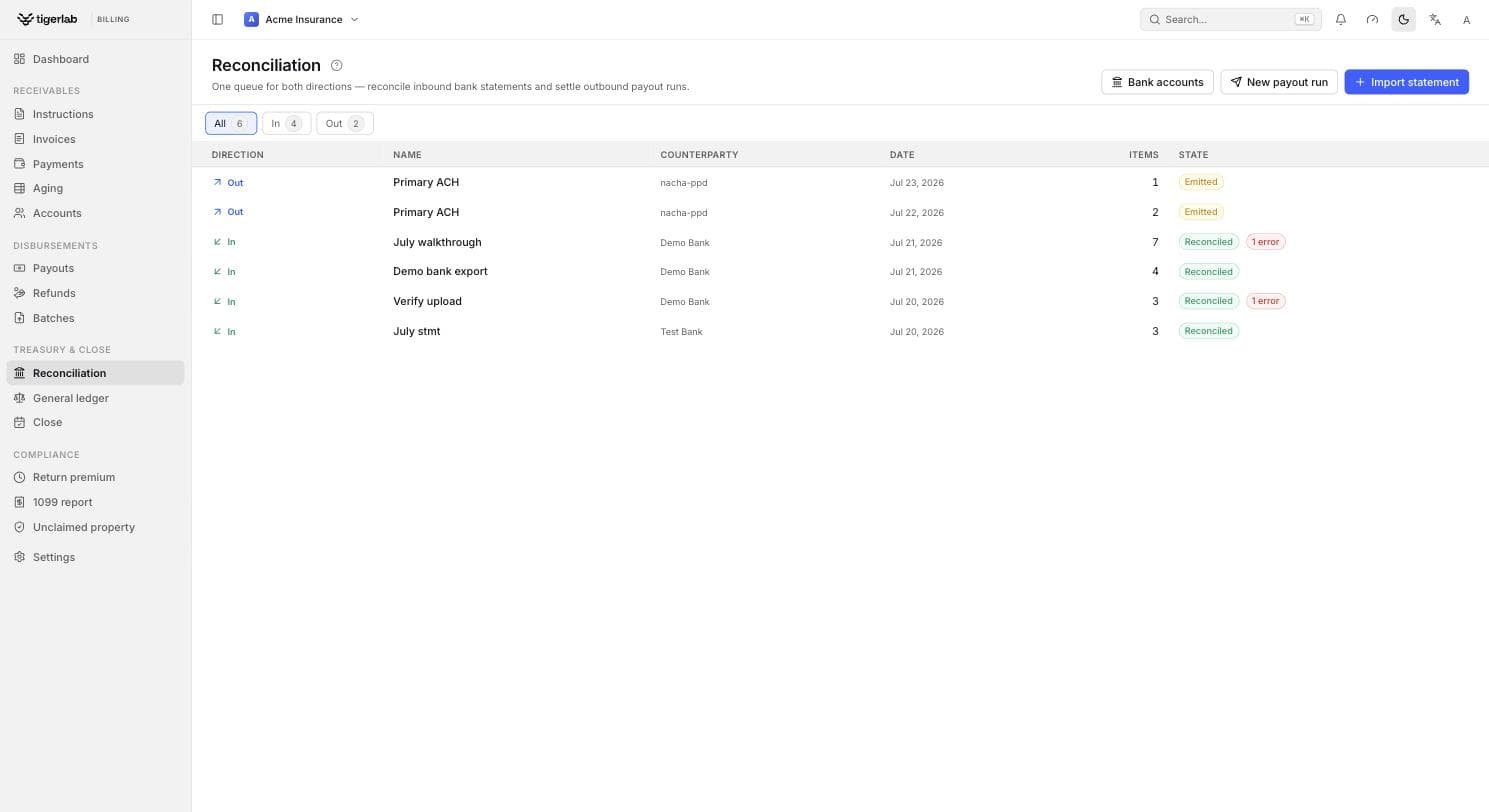
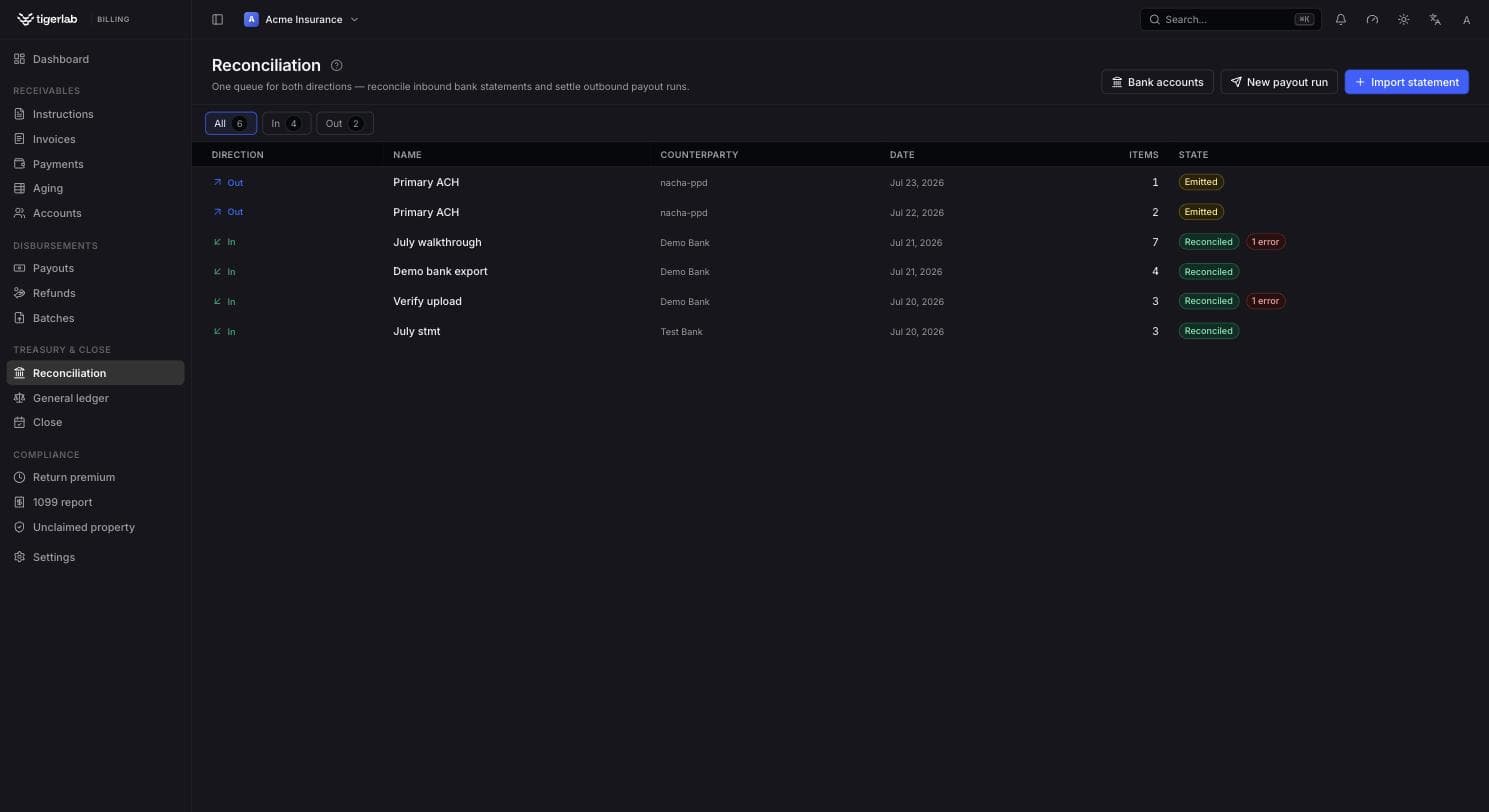
One queue for money in and out
Reconcile inbound bank statements and settle outbound payout runs from a single tiered-matching queue.
Capabilities
Premium billing & instructions
Every policy transaction arrives as an idempotent instruction carrying premium, tax, and fee deltas, applied through a single write path.
Payment plans & invoicing
Versioned payment plans with live schedule previews, account-centric invoice streams, aging, and PDF invoices emailed to payers.
Cash application
Record receipts manually, by gateway, or by bank file, with oldest-due-first allocation and partial payments, overpayments, and suspense as first-class exceptions.
Payment gateways & autopay
A provider-agnostic gateway layer with tokenized instruments, autopay mandates, signed webhooks, and collection runs.
NSF & chargebacks
Automatic reversals restore the receivable, reopen the invoice, assess an NSF fee, and track retries — never a delete.
Bank reconciliation
Upload a statement and auto-match in tiers with category-grouped bulk resolution, streaming files with hundreds of thousands of lines.
Disbursements & payout reconciliation
Rail-agnostic payouts for refunds, commissions, and remittances through ISO 20022 and NACHA rails, with a sanctions gate and outbound tie-out.
Regulatory queues
Return-premium deadlines, escheatment of unclaimed property, and 1099 reporting tracked as dedicated queues with per-state configuration.
Period close
A close cockpit where GL tie-out checks must clear and compliance items advise, producing an immutable close record.
A clean, defensible boundary
Standalone-ready, and built to slot into the tigersuite.
- Ingests rated charges from policy administration
- Provider-agnostic payment gateways, Stripe first
- ISO 20022 and NACHA payout rails
- GL export to your accounting system
- Hard multi-tenant isolation via database row-level security
Frequently asked questions
Does tigerbilling rate policies or calculate premium and taxes?
No. It starts once a policy is bound and its price is known; the policy system rates and calculates premium, taxes, and product fees, which arrive as typed charges. tigerbilling computes only payment-plan fees such as installment, late, and NSF fees.
Is it a payment processor?
No. It orchestrates payment gateways — Stripe first — through a provider-agnostic layer with tokenized instruments and autopay. Orchestration yes, card acquiring never.
Can it run against a third-party policy system, or only your suite?
It is built as a standalone product first, with a contract-shaped billing-instruction ingestion surface; deeper suite integration with the policy and distribution systems layers on top.
How does it keep every number auditable?
A single append-only double-entry ledger is the only write path and validates that debits equal credits; every amount on screen can be reconstructed from its postings, and reversals replace edits.
How does it handle insurance-specific regulatory obligations?
Statutory return-premium deadlines, escheatment of unclaimed payouts, and IRS 1099 reporting are tracked as dedicated queues with per-state configuration rather than by hand.
How is tenant data isolated?
Each tenant is resolved per request and isolated by Postgres row-level security enforced through a restricted database role — enforced even in the test suite.